Promises Meet Their Price
7 stories · ~7 min read
Listen
If You Only Read One Thing
A guarantee matters only when somebody might collect. Two drone strikes on UAE tankers turn Washington's security promise into The Strait Prices Washington. Nvidia's smaller OpenAI backstop makes Nvidia Stops at Five Gigawatts a test of how much customer risk the chipmaker will absorb. Different systems, same question: who owns the loss when the promise fails?
The Strait Prices Washington
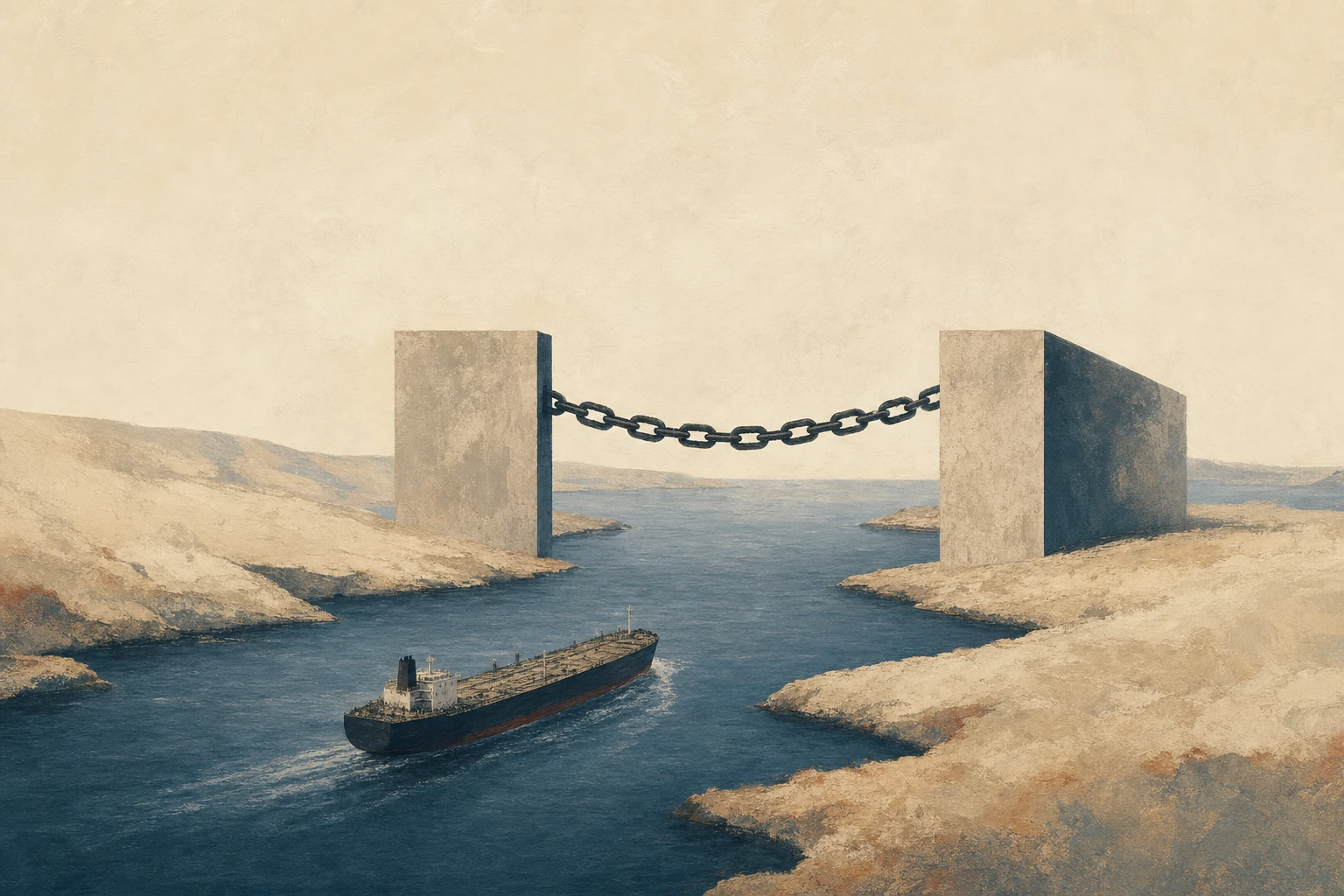
Iran is not merely disrupting the Strait of Hormuz. It is converting passage through the world's most important oil chokepoint from an assumed right into a permission that Tehran can negotiate. That change makes the Gulf states reassess what the American security guarantee actually buys.
The immediate evidence is deliberately below the threshold of a decisive military response. The UAE says drones struck two ADNOC tankers transiting the strait on Thursday, causing minor damage but no injuries; the UK Maritime Trade Operations center separately recorded two drone-damaged vessels. Abu Dhabi called the attacks piracy and economic coercion. Iran did not immediately respond to the allegation. Minor damage is the mechanism, not evidence that the mechanism failed: repeated low-cost strikes can raise insurance, deter crews and slow traffic without giving Washington a clear trigger for war.
Diplomacy now reflects that constraint. After US-Iran talks stalled, Secretary of State Marco Rubio contacted the foreign ministers of Greece and Austria; both spoke with Iran's foreign minister the next day. Greece carries weight as a major shipping nation, while Austria hosts the IAEA and the site of the old nuclear negotiations. Iran describes the discussions as exploring “mechanisms for future management” of Hormuz. Washington once demanded immediate, toll-free passage. It is now searching for intermediaries to negotiate the terms of access.
That is a larger strategic loss than another week of expensive oil. A fifth of global oil normally moves through the strait, and Gulf monarchies have treated their alignment with Washington, especially since 2019, as an implicit exchange: political and commercial cooperation for protection of export infrastructure. The strongest counterargument is that wider mediation may produce a durable formula precisely because Greece and Austria are less threatening to Iran. But a formula that lets Tehran “manage” passage also recognizes Tehran as the gatekeeper. The United States would have helped negotiate a license for commerce it previously promised to secure.
Wednesday's briefing tracked Iran's shift from striking oil infrastructure to threatening its detours. The new development is that Washington's partners are no longer waiting for US force to reopen the route; they are helping assemble a settlement around its failure to do so. That will push Gulf capitals toward redundant security relationships and more independent channels to Tehran, even if they remain American allies.
Watch one number: ordinary commercial transits per day. A negotiated announcement without seven consecutive days above half the prewar daily baseline would price the American guarantee in rhetoric, not capacity.
Nvidia Stops at Five Gigawatts
Nvidia has found the limit of circular AI finance: its balance sheet can promote demand, but investors do not want it to insure an entire customer's ambition.
The chipmaker and OpenAI are nearing a financing agreement for SB Energy's planned 10-gigawatt Ohio campus, but the structure has changed. Nvidia would initially backstop only the first phase, about five gigawatts, and decide later whether to support the rest. The proposed guarantee has fallen from $250 billion to less than $120 billion, partly to address investor concern about Nvidia's exposure, Reuters reports, citing The Wall Street Journal. OpenAI is still discussing a binding lease for the full campus. Separately, CNBC reports that Nvidia has discussed a $3 billion investment in SB Energy, half at signing and half around a possible IPO.
A guarantee is not chip financing with another label. It substitutes Nvidia's credit for OpenAI's, allowing lenders and the developer to underwrite the tenant against the supplier's capacity to pay. That makes finance part of Nvidia's distribution system: help the customer secure a campus, and the campus becomes a long-duration buyer of Nvidia hardware. But it also concentrates project, tenant and technology risk in the company selling the equipment. The market is forcing Nvidia to separate the two jobs.
The revised structure is an option, not an exit. Nvidia can support the first five gigawatts, preserve chip demand and buy equity upside in SB Energy while making later phases prove themselves before it adds contingent liabilities. This is the missing boundary in the $500 billion credit market described last week: Wall Street may finance AI infrastructure, but only after somebody credible agrees to take losses before the lenders do.
The bullish case is that Nvidia's exposure is safer than the headline suggests. OpenAI demand is vast, and a power-rich campus full of market-leading accelerators could find another tenant. Yet data-center collateral is not a pile of liquid GPUs. Moody's separates announced capacity from delivered infrastructure because permitting, energization, commissioning and utilization each determine whether a project generates cash. A specialized 10-gigawatt lease cannot be reassigned as quickly as a cloud instance.
The cut therefore does not prove that AI demand is collapsing. It proves that even the industry's largest beneficiary wants a staged claim on that demand rather than an unconditional obligation. Watch the signed lease: a guarantee confined to the first five gigawatts confirms that optionality, while support for all 10 would show that investor pressure did not change the final allocation.
The Contrarian Take
Everyone says: Cutting the guarantee proves Nvidia sees the AI bubble and is backing away.
Here's why that's wrong (or at least incomplete): Nvidia is still considering almost $120 billion of support for the first phase and $3 billion of equity in the developer. It is replacing an unconditional backstop with a staged option, leaving later capacity to earn financing after the first tranche is built. That is bearish for the ease of funding speculative campuses, not necessarily for near-term accelerator demand. The truly negative signal would be OpenAI failing to sign even the phase-one lease, or outside lenders refusing a structure Nvidia does guarantee.
Under the Radar
-
The construction boom outruns last year. US data-center projects worth $22.3 billion broke ground in June, the second-highest month on record. Starts reached $81.5 billion through June, already above 2025's full-year $72.5 billion. The buildout is becoming concrete, but median cost per square foot rose 38% year over year. More capacity is starting precisely as every unfinished gigawatt becomes harder to finance. (Source)
-
Utilities stop waiting for perfect quantum computers. More than 300 organizations are collaborating with quantum companies, while Chattanooga utility EPB plans to install a 36-logical-qubit system this year. Grid operators are testing battery placement, dispatch and maintenance before hardware reaches the expected 100-logical-qubit threshold around 2028–30. The near-term market may be operational learning sold alongside hardware, not a clean moment of quantum advantage. (Source)
Quick Takes
Anthropic Puts Compliance in the Decoder
Future Claude models will select among semantically similar words using a secret key and preceding text, creating a detectable statistical watermark without hidden characters or extra tokens. The EU AI Act has moved compliance inside model generation rather than leaving it to a label pasted onto the output. The catch is decisive: rewriting can weaken the signal, so detection indicates model involvement, not authorship. (Source)
Grok's Abuse Case Becomes Quantitative
A new plaintiff says her stepfather used Grok to turn a photo taken when she was 11 into more than 7,000 explicit images. She joins three Tennessee teenagers seeking class-action status against xAI. The number changes the liability question: foreseeable abuse is no longer one malicious prompt but an industrial workflow. Rate limits, repeat-use detection and evidence retention become product controls a court can examine. (Source)
Qwen Wins the Derivative Flywheel
Qwen now underlies 151,448 Hugging Face derivatives, 2.6 times Meta's total, and attracts 180–210 new repositories a day. Models below one billion parameters account for 83% of all downloads, suggesting distribution breadth matters more than frontier scale in the open ecosystem. Hugging Face activity is not total market share, but it shows Alibaba accumulating the complements: fine-tunes, formats and local deployment paths. (Source)
The Thread
A guarantee transfers confidence only if the guarantor can absorb the loss. Once a claim becomes plausible, counterparties stop valuing the promise at face value and start pricing its enforcement machinery: ships, insurance and diplomacy in Hormuz; collateral, power and staged commitments in Ohio. Both deep stories are therefore about the same migration of risk from words to enforceable capacity.
The supporting items show the same separation between declaration and enforcement at smaller scale. A watermark can establish probability, not authorship. A safety policy means little if one user can produce thousands of abusive images. An open license acquires economic weight only when a downstream community builds around it. The durable asset is not the promise. It is the system that makes the promise costly to break.
Predictions
New predictions:
- I predict: By September 15, US or Iranian officials will publicly outline a third-party monitoring or access-management mechanism for Hormuz without Iran committing to unconditional toll-free passage. This is wrong if no such mechanism is outlined by then, or if Iran first makes an unconditional toll-free commitment. (Confidence: medium; Check by: 2026-09-15)
Issue date: 2026-08-16 · Generated: 2026-08-16 03:45 AM EDT
Tomorrow morning in your inbox.
Subscribe for free. 10-minute read, every weekday.