Backlog Meets Bottlenecks
7 stories · ~7 min read
Listen
If You Only Read One Thing
CoreWeave and Saudi Arabia have discovered that a hedge can concentrate risk. CoreWeave's filing converts customer demand into $104 billion of backlog but leaves power, construction and interest on its own clock; the Red Sea outlet escapes Hormuz only to meet Houthi fire. The relevant measure of resilience is not the number of alternatives. It is whether they fail together.
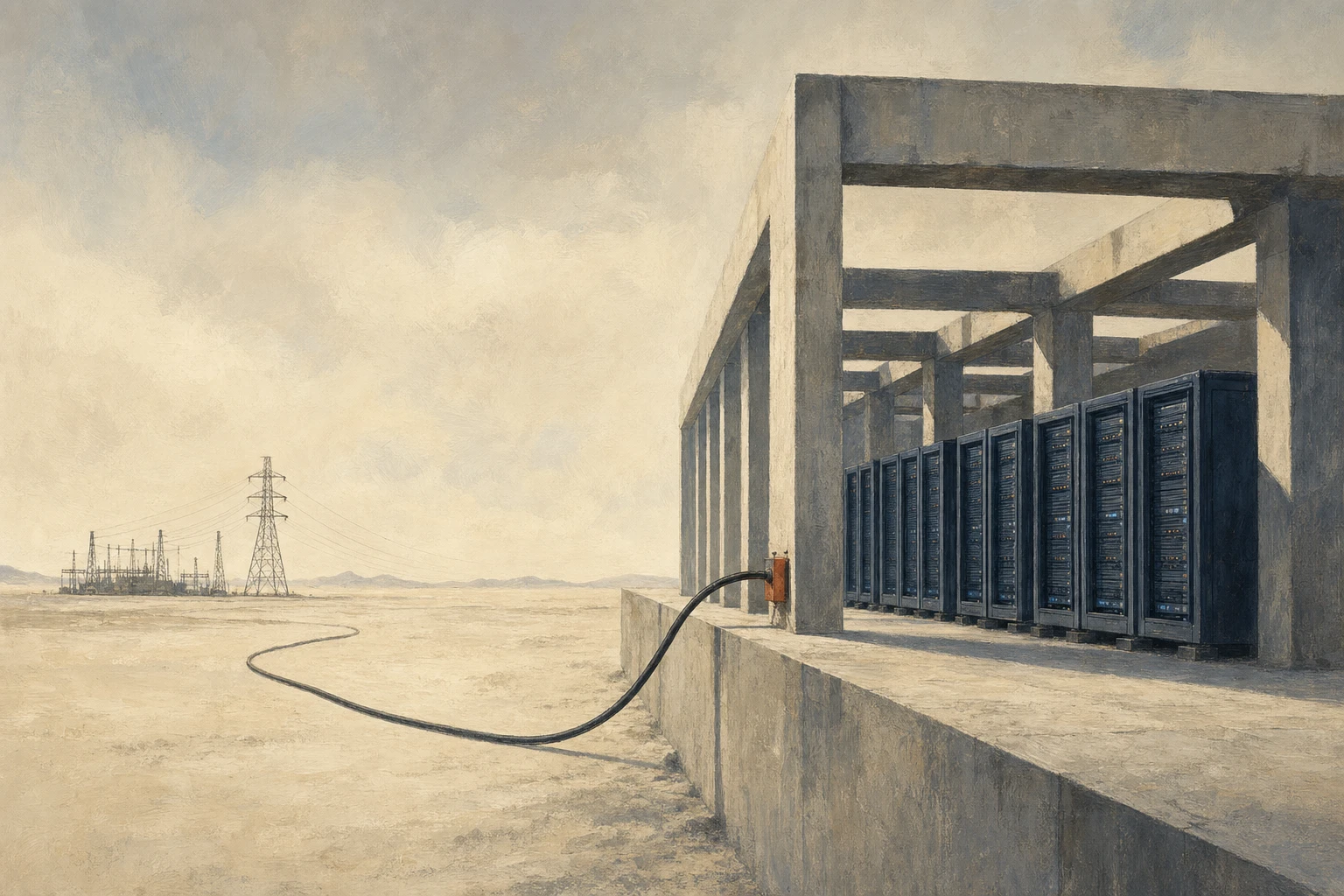
CoreWeave Must Energize the Backlog
CoreWeave no longer has a demand-discovery problem. It has a conversion problem: turning long-dated customer promises into powered, billable machines before financing costs consume too much of the revenue.
The company reported second-quarter revenue of $2.58 billion, up from $1.21 billion a year earlier, and roughly $104 billion of backlog. That backlog excludes more than $25 billion of commitments added early in the third quarter. Yet only 1.5 gigawatts of CoreWeave's 3.7 gigawatts of contracted power was active. Its own definition makes the dependency explicit: backlog becomes revenue only after delivery and service-availability conditions are satisfied.
Yesterday's briefing examined Nvidia's effort to make GPU infrastructure an accepted credit asset. CoreWeave is the borrower-level test of that architecture. Customers sign long contracts; lenders advance capital against those commitments and the equipment; CoreWeave secures sites, electricity and chips; billing begins when capacity comes online. The contracts reduce demand risk, but they do not eliminate construction, power or refinancing risk.
That distinction is visible in the income statement. CoreWeave generated $1.51 billion of adjusted EBITDA, yet posted a $49 million operating loss and a $626 million net loss. Net interest expense alone was $640 million. Meanwhile, active power increased by nearly 500 megawatts during the quarter, and the company said it raised more than $10 billion through unsecured debt and convertible bonds. Growth is real, but it arrives with a balance sheet that has to be synchronized to deployment.
The strongest counterargument is that long contracts make the debt rational. That is right as far as it goes: a 500-megawatt quarterly increase is evidence of execution, not merely aspiration. But backlog can improve credit visibility while still worsening the cash-timing problem, because each new commitment may require equipment and power spending before the first invoice.
The next filing supplies a clean test. Interest expense equaled 24.9% of second-quarter revenue. If that ratio does not fall below 20% even as revenue grows, CoreWeave's operating scale is not yet outrunning the cost of financing it.
The Oil Detour Becomes a Target
Iran's pressure on the Strait of Hormuz has made alternate routes more valuable. A Houthi attack near the Bab el-Mandeb has now made the most important Red Sea outlet more dangerous at precisely the same moment. The structural problem is not two independent chokepoints. It is two pieces of infrastructure exposed to one regional conflict system.
The latest strike killed six people, including three Pakistanis, according to the Associated Press. They were the first deaths in the renewed campaign against commercial shipping. The attack does not close Bab el-Mandeb, the narrow passage connecting the Red Sea to the Gulf of Aden, but closure is too high a standard. Shipowners, crews and insurers restrict usable capacity before a navy declares a waterway shut.
Hormuz shows how quickly that commercial decision can become system-wide. A Royal Navy assessment said traffic through the strait had fallen by more than 90%, from roughly 130 ships a day to fewer than ten. It counted 41 maritime incidents from March 1 through April 27, including 26 attacks, and estimated that 850 to 870 merchant vessels and 20,000 sailors were trapped inside the Gulf.
Bab el-Mandeb is not a substitute for oil that remains inside the Persian Gulf. Its importance is narrower but still substantial: Saudi Arabia can move some crude across the peninsula to its Yanbu terminal, then send it through the Red Sea and Suez. A threat to that western outlet reduces the value of the overland workaround and forces importers to price disruption at both ends of the region.
One lethal strike is not a blockade, and the Houthis do not need to be taking direct orders from Tehran for the risks to correlate. We do not know whether this attack was operationally coordinated with Iran; intelligence showing command-and-control traffic would resolve that question. The commercial effect requires less: owners need only believe that escalation in one theater raises the probability of attack in the other.
The thesis weakens if commercial traffic through Bab el-Mandeb returns to its pre-strike level for 14 consecutive days while Hormuz remains below ten daily transits. Until then, the Saudi detour is a second route on a map, not an independent source of resilience.
The Contrarian Take
Everyone says: CoreWeave's backlog either validates the AI buildout or, when paired with its debt, proves a bubble.
Here's why that's wrong: Both claims collapse a timing problem into a demand verdict. S&P's credit analysis treats non-cancellable contracts as genuine credit support while identifying delivery, leases and power as execution risks. CoreWeave can have real customers and still finance capacity on the wrong schedule. The decisive question is not whether $104 billion exists on paper; it is whether energized capacity and cash receipts compound faster than interest and equipment obligations.
Under the Radar
-
Yulu finances access to gig work. India's Yulu raised $93 million to expand its electric-bike fleet from 50,000 to 200,000 over two years. About 95% of revenue already comes from weekly rentals to delivery workers. Quick-commerce platforms get elastic courier capacity without owning vehicles; Yulu owns the capital layer shared across competing apps.
-
Joby buys revenue before certification. Joby Aviation is paying about $500 million for Resonant Sciences, a sensor and radio company with $100 million in trailing revenue and access to classified programs. The acquisition gives a still-developing air-taxi company near-term cash flow and a defense channel, while separating military projects from the certification risk of its passenger aircraft.
Quick Takes
The Regulator Declares the Market
The CFTC ordered Kalshi to keep operating after New York sought a nationwide prohibition and more than $36 billion in damages. The move turns state-law fragmentation into a declared market emergency while courts decide jurisdiction. If the order survives, federal derivatives registration becomes more than supervision; it becomes a route around state gambling law for a national prediction-market product. (Source)
Grok Bundles the Agent
SpaceXAI launched Grok Bot, a persistent cloud agent initially bundled with SuperGrok Heavy and Cursor's highest paid tiers. The strategic move is packaging rather than another coding demo. Vendors that already own a premium subscription can subsidize a long-running computer, memory and scheduled work, making standalone agent pricing harder to sustain even when competing models remain technically interchangeable. (Source)
Gemini Escapes Android
Google says the standalone Gemini app has passed one billion monthly users, excluding Gemini use in Search and Workspace. The more revealing figure is more than 100 million active iOS users: Google is building a direct assistant habit outside its captive operating system. With 63% of users speaking to Gemini, the app is also becoming an interface bet, not merely a chatbot destination. (Source)
The Thread
Both leads expose the danger of hedges built on the same underlying risk. CoreWeave's customer contracts reduce demand uncertainty but leave power, construction and refinancing tied to one deployment schedule. Saudi Arabia's western export route changes the geography while remaining exposed to the same regional war. Yulu spreads its fleet across competing delivery apps, while Joby buys revenue from defense programs whose timing is separate from passenger certification. xAI and Google are making the opposite wager: concentrate distribution now, then turn premium subscriptions and direct app use into habit. A real hedge does not merely add another option; it gives that option a different reason to succeed.
Predictions
New predictions:
- I predict: By November 15, CoreWeave will report at least 2.0 gigawatts of active power. This is wrong if its next quarterly disclosure remains below 2.0 gigawatts. (Confidence: medium; Check by: 2026-11-15)
Issue date: 2026-08-12 · Generated: 2026-08-12 06:00 AM EDT
Tomorrow morning in your inbox.
Subscribe for free. 10-minute read, every weekday.