Anduril Joins the Shipbuilders
8 stories · ~7 min read
Listen
If You Only Read One Thing
The next industrial challenger may make the incumbents stronger. Anduril’s submarine expansion supplies established shipbuilders, while Google’s nuclear agreement pays an established generator to produce more. These are investments in the missing pieces around existing systems. The opportunity belongs to companies that can turn new capital into certified output, even when another business retains the final customer and the franchise.
Anduril Enters Through the Parts
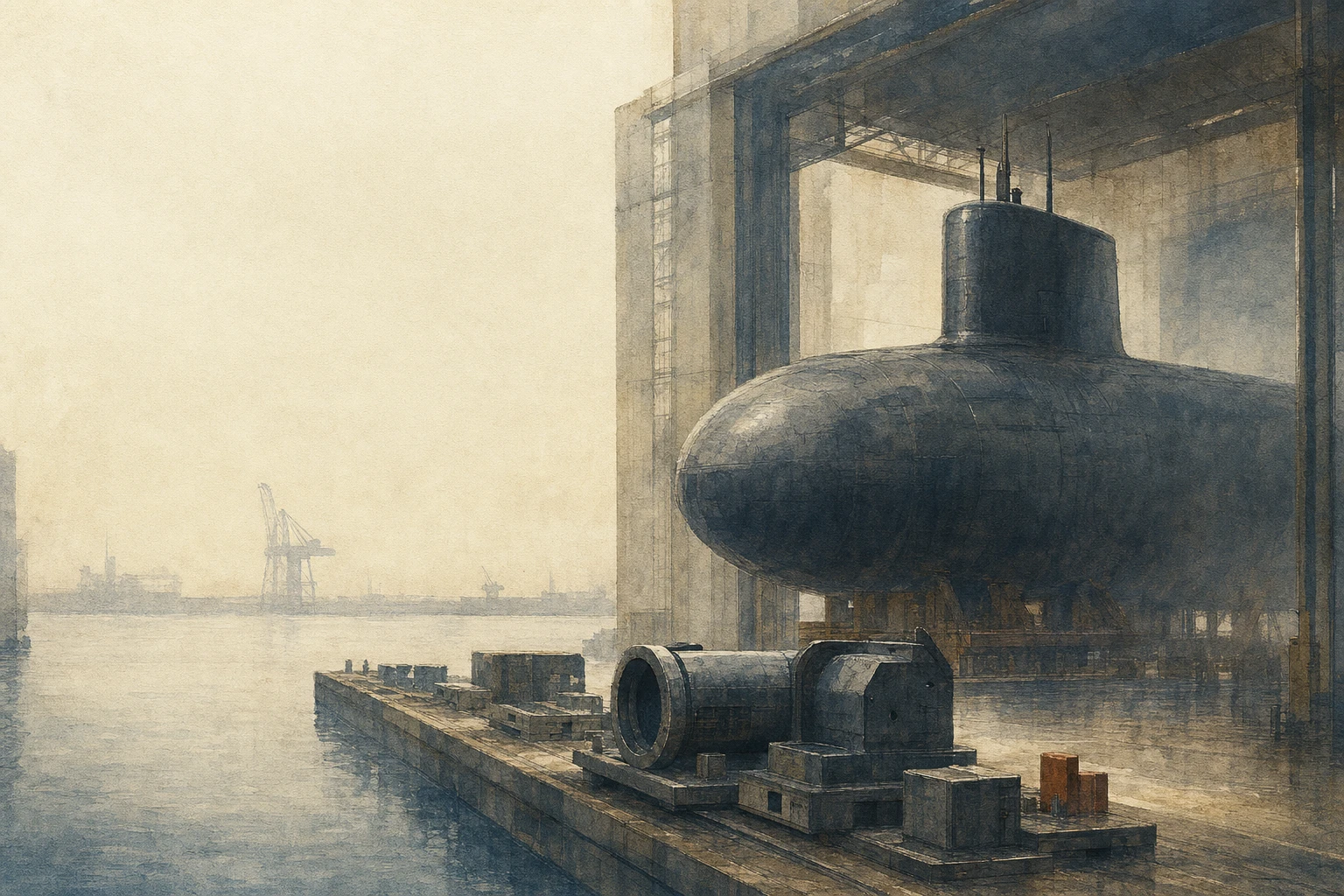
Anduril’s move into submarine manufacturing could strengthen the shipbuilders it might appear to threaten. The company is entering their supply chain, where one missing component can delay an otherwise valuable vessel. That makes the investment a bet on relieving production constraints, rather than winning the entire submarine contract.
The October 6 announcement pairs $3.7 billion of planned private investment with a Navy contract worth up to $2.9 billion. Maryland’s official announcement describes a two-million-square-foot facility at Sparrows Point and more than 3,100 permanent jobs. Those are project commitments and forecasts, not current output.
The starting product explains the strategy. In USNI’s reporting from the announcement briefing, an administration official identified torpedo tubes as a component holding up submarines already under construction. Anduril wants to progress toward larger sections, while General Dynamics Electric Boat and HII’s Newport News remain the prime builders.
Think of a nearly completed house waiting for an approved electrical panel. Another crew building walls does little; a qualified panel supplier can bring the completion date forward. Submarine manufacturing adds much stricter certification requirements, which is why the value lies in accepted components rather than factory floor space alone. Anduril is buying entry into that qualified-supplier base.
The financing also changes the incentive. Anduril says Navy payments depend on demonstrated production outcomes. That gives the company a reason to improve throughput and absorb some execution risk, but the public contract summary does not establish every cost-overrun or cancellation term. A ceiling on potential payments should not be read as cash already received.
The strongest objection is that software cannot instantly reproduce specialized manufacturing experience. New facilities still need qualified workers, materials and inspection processes. Better scheduling can reduce idle time; it cannot make a defective part acceptable. The test is whether Anduril adds usable capacity instead of simply bidding experienced people away from existing suppliers.
My medium-confidence investment read favors qualified component and manufacturing-equipment suppliers over the next three to five years. General Dynamics and HII could also benefit if reliable inputs let them complete more contracted work. This extends the capacity argument in September 16’s defense briefing: demand is already present; conversion into deliveries determines the return. The read fails if extra supplier spending leaves completion rates unchanged.
The first useful milestone is a disclosed Navy acceptance of Anduril-produced components, with delivery quantities rather than projected factory employment.
Google Buys More From What Exists
Google approaches the same capacity problem as a buyer: its nuclear deal rewards ownership of operating infrastructure. Constellation can add power by improving existing reactors, giving it new sales without completing an entirely new nuclear site. The commercial advantage is the installed plant, its workforce and the ability to expand its output.
The companies’ October 6 agreement supports 890 megawatts of additional nuclear capacity across 11 units. A 20-year purchase commitment underpins more than $4.3 billion of planned Constellation investment. The joint announcement expects the first increase by 2028. That milestone does not mean the full capacity is available then.
The mechanism is called an uprate: upgrading an existing plant so it can safely produce more electricity. Better turbines, steam equipment and controls can extract more output from infrastructure already in service. Like expanding a working factory, the project starts with valuable foundations in place. Nuclear safety approval and installation work still stand between an engineering plan and saleable power.
Google supplies the other missing input: confidence that someone will buy the electricity for long enough to justify the investment. That reduces Constellation’s exposure to future market demand. It does not remove construction risk or tell outside investors the contract’s profitability, because the announcement gives no power price or project return.
This advances a different part of the energy story from October 1’s permitting proposal. That bill could help competing supply reach customers. This signed commercial agreement supports more production at existing assets. Both can ease scarcity, but only the latter presently identifies a buyer and a supplier committing to an expansion.
The counterargument is timing. Datacenter demand can arrive before reactor upgrades, and concentrating work across an existing fleet still creates outage and execution demands. Google’s purchase commitment makes the work easier to finance; it cannot make all the power arrive with the first project. Regulatory review also remains a separate process from commercial agreement.
My medium-high-confidence operating read favors Constellation and qualified nuclear-upgrade suppliers through 2032. The standing pattern is value moving from AI hardware toward the scarce infrastructure that powers it. Existing sites offer a more concrete earnings pathway than an undifferentiated bet on every proposed reactor. That is a business advantage, not proof that any stock price is attractive. Cost escalation or weak contract returns could consume the benefit.
The decisive delivery test is whether the first uprate actually enters service by the announced 2028 milestone.
The Contrarian Take
Everyone says: Big Tech paying for new nuclear power should settle the argument over whether datacenters raise other customers’ electricity costs.
Here’s why that’s incomplete: Financing an upgrade and protecting every customer from market-price effects are different tests. Alongside the 890-megawatt expansion, the Constellation agreement includes 2,700 megawatts of existing supply under a separate 15-year arrangement. New capacity therefore represents about 24.8% of the combined 3,590-megawatt package; the existing-power agreement is not evidence of another 2,700 megawatts being built. The companies say generation remains available to the regional grid, so this is not proof that households lose access to it either. The unresolved economic question is how quickly total supply grows relative to total demand: privately funded construction can protect customers from a direct project charge while electricity prices still respond to scarcity.
Under the Radar
-
Maryland is also financing the workforce. State and county commitments would match up to 13% of Anduril’s anticipated private investment, implying as much as $481 million against the $3.7 billion base. The state announcement says new appropriations require legislative approval and includes support for a training center. The economic distinction is whether assistance develops additional qualified workers or merely subsidizes relocation from another shipyard; the announced job count cannot answer that.
-
Google’s energy supplier becomes a software customer. The power agreement also includes a five-year technology alliance in which Constellation plans to deploy Google Cloud and Gemini Enterprise in its operations. The companies describe applications in planning, construction and plant performance. This creates a second commercial relationship around the physical one. No disclosed software contract value or measured productivity gain establishes how much of Google’s electricity spending could return as profitable cloud revenue.
Quick Takes
-
Skydance now owns the coordination problem. Paramount completed its Warner Bros. Discovery acquisition October 6, bringing HBO Max and Paramount+, CNN and CBS under one company. Closing changes who can coordinate catalogs and distribution; it does not demonstrate profitable integration. My medium-confidence read over the next two years favors the combined owner’s bargaining position, conditional on retaining audiences. Subscriber losses or integration costs exceeding savings would weaken that case. (Source)
-
Korea’s banking breach becomes a sector-wide problem. President Lee Jae Myung said October 6 that signs of AI use had emerged in bank hacks; the tools and full breach scale remain undisclosed. The financial regulator’s warning is broader: interconnected services can transmit one institution’s vulnerability across the sector. The business risk is shared exposure and response cost, even before investigators establish how much automation helped the attackers. (Source)
-
Mistral puts sovereignty into a live service. Mistral Large 4 entered public API preview October 6, trained and served on the company’s own European infrastructure. Downloadable weights are promised for month-end. That advances the infrastructure strategy covered September 8 into an available product, while independent customer operation remains prospective. Local operating control can differentiate the supplier before it establishes superior margins or broad customer switching. (Source)
-
DayOne’s growth has one dominant payer. The Singapore datacenter operator’s newly announced IPO filing reports first-half revenue of $512 million, up from $151.5 million a year earlier. Its largest customer supplied 69.2% of that revenue. The investment exposure is therefore much more concentrated than the phrase “global AI infrastructure” suggests: rapid expansion can deepen dependence on one counterparty even while the geographic footprint broadens. (Source)
The Thread
Industrial coordination does not always require an acquisition. Google can support reactor investment with a purchase commitment while Constellation retains the plants. Anduril can supply a missing component while established builders retain the submarine contract. My inference is that a measurable delivery gives companies a way to coordinate investment without assuming responsibility for each other’s entire business.
That puts a boundary on the ownership argument in October 5’s Schneider story. Buying a company makes sense only if control adds enough value beyond what a contract could achieve. Skydance now faces that test across its combined media portfolio: common ownership creates permission to coordinate, while management still has to produce benefits that a licensing partnership could not. Scarce assets can earn more without changing owners; acquiring them adds a separate burden of proof.
The distinction would weaken if repeated delivery disputes forced the industrial buyers to take ownership of suppliers. Successful contracted expansions alongside disappointing merger returns would strengthen it. The investment question is therefore how much control an additional dollar buys, and whether that control improves the output customers actually receive.
Predictions
- I predict: Mistral will publish downloadable Large 4 weights by October 31. A live preview and an explicit release timetable support the call; the ongoing security testing is the main stated uncertainty. Continued API-only access would falsify it. (Confidence: medium; Check by: 2026-10-31)
Issue date: October 7, 2026. Prepared at 03:27 AM ET.
Tomorrow morning in your inbox.
Subscribe for free. 10-minute read, every weekday.