China’s Truce Runs Short
7 stories · ~7 min read
Listen
If You Only Read One Thing
Washington and Beijing bought two more months; Akamai committed to years of construction. The US–China summit and Akamai’s Anthropic agreement expose a widening mismatch between political assurances and investment payback. A trade extension can support another shipment. A cloud contract must support equipment bought long before revenue arrives. The useful question is how much future each agreement actually makes financeable.
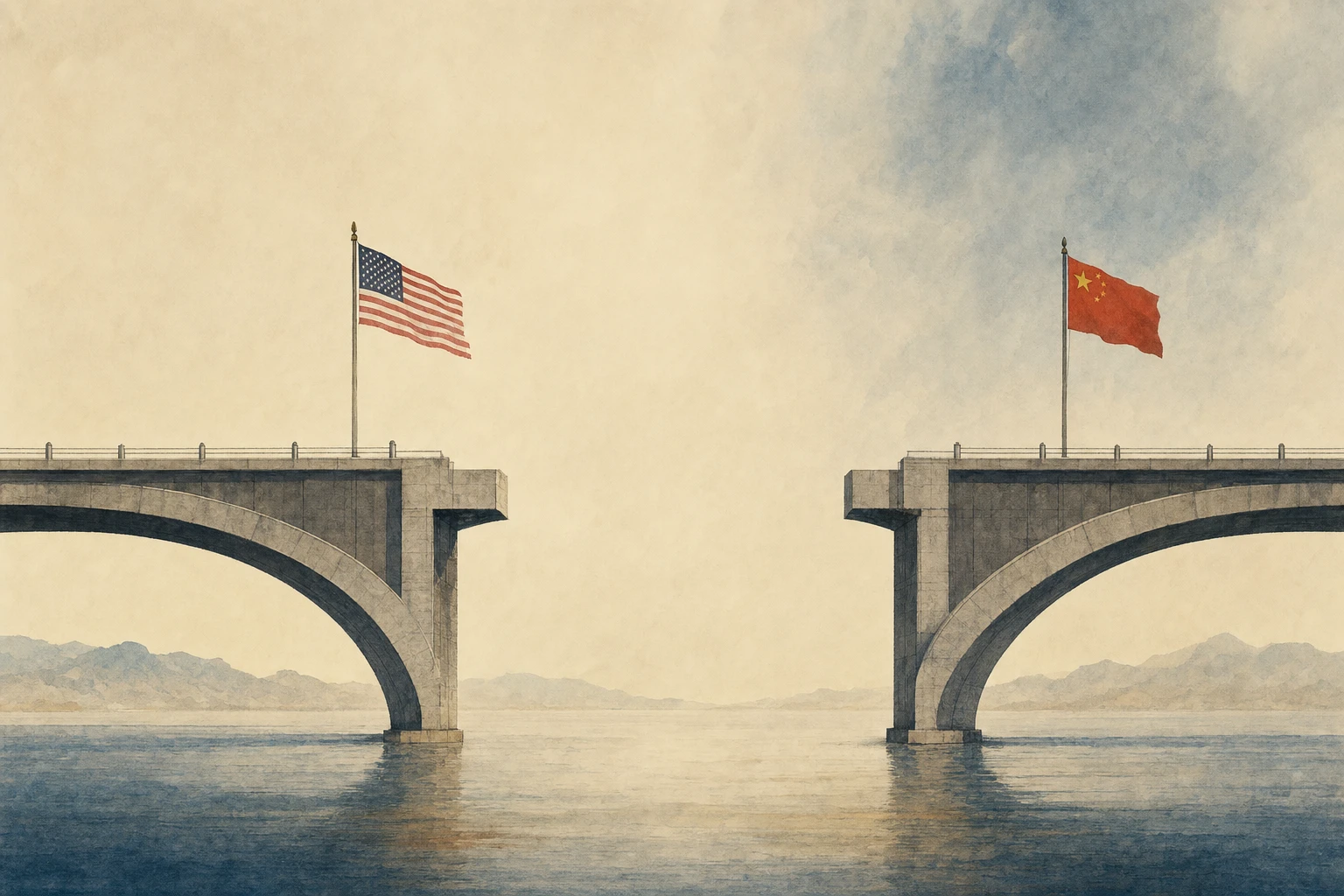
China’s Truce Is Too Short for a Factory
The Washington summit gives businesses more time to trade, but little additional reason to rebuild their supply chains around political reconciliation. Its clearest economic result is a short extension of existing arrangements. That favors companies capable of adjusting orders quickly over companies whose next investment requires years of predictable market access.
Bessent announced that the trade truce’s November 10 expiry moves to January 10. His September 23 interview supplies the dates. Thursday’s summit then produced no reported breakthrough across the central disputes over trade, Taiwan, AI or Iran, according to Reuters’ account. An announced extension is also distinct from the implementing notices that determine treatment at the border.
A temporary truce changes the value of waiting. Think of a retailer deciding between another seasonal order and a manufacturer deciding where to install machinery. The retailer can finish much of the transaction inside the political window. The factory must earn back its cost after that window closes. Both benefit from calmer relations, but only one can readily match its spending to the assurance being offered.
This answers Tuesday’s summit test with an extension, not a durable settlement. It also differs from Monday’s proposed AI notification channel, which concerned managing a shared hazard. The new deadline governs the commercial bargain’s duration; neither development establishes a broad reopening of restricted technology markets.
The strongest counterargument is that repeated short extensions can become durable stability in practice. That is plausible: both governments have reasons to avoid another economic shock. CSIS’s pre-summit analysis identified domestic economic constraints on both sides. Yet a company financing a plant cannot assume that the next extension will arrive on the same terms simply because the previous one did.
My investment read is moderately confident: over the next two quarters, established importers with flexible orders and alternative sourcing are better positioned than projects whose returns require permanent tariff normalization. This extends the standing pattern of policy determining market access, without treating every diplomatic meeting as a reversal of industrial separation. A longer agreement with enforceable product coverage would weaken that preference. The concrete test is whether the next published tariff instrument reaches beyond January 10 and specifies which goods qualify.
Akamai Pays Before Anthropic Arrives
Akamai’s AI opportunity comes with an immediate cash requirement and a delayed revenue stream. The company has secured a large customer, but shareholders are also financing a substantial buildout before that customer reaches full consumption. The contract’s timing matters more than its headline total.
The September 24 announcement establishes $11.6 billion of commitments over seven years for Anthropic’s CPU workloads: the general-purpose computing surrounding AI systems. Akamai estimates $5.5 billion of related capital expenditure. The arrangement also includes a warrant, an option to purchase shares, potentially equivalent to about 5% of Akamai’s outstanding common stock if the commercial relationship expands.
The spending schedule makes the burden concrete. Akamai’s investor presentation projects $1.7 billion of additional capital spending this year and $3.1 billion next year. Service initiation is expected in late Q2 2027, with only $150 million–$300 million of revenue during 2027. The full contracted revenue run rate is expected by the end of 2028. These are management estimates, not delivered results.
That changes where the investment exposure sits. Anthropic buys a future service; Akamai must assemble the inputs now. The SEC filing authorizes Jabil to purchase approximately $1.7 billion of memory components, with Akamai paying corresponding supplier invoices on receipt. The order supports the standing pattern of AI demand spreading beyond accelerators into other scarce hardware. It does not establish which memory manufacturer ultimately captures the margin.
The counterargument deserves weight: a contractual customer can make a buildout much more financeable than speculative capacity. But the filing conditions the commitment on delivery and availability requirements, and gives Anthropic specified termination rights, including for qualifying material outages. Contracted demand reduces commercial uncertainty; it does not remove execution risk.
My moderately confident investment read favors equipment suppliers with authorized purchases over the next 12–24 months, while Akamai’s longer-term upside depends on conversion into cash after operating and financing costs. Canceled purchases or a substantial service delay would weaken that judgment. Unlike yesterday’s Italian nuclear opportunity, these purchases precede a named customer’s service start, not an unawarded project. Oracle’s prepayments supplied a different financing model. Akamai’s next quarterly filing should provide the full service agreement; the test is how its delivery milestones and remedies align with the already-authorized purchases.
The Contrarian Take
Everyone says: A large cloud contract demonstrates that the infrastructure provider has captured the AI opportunity.
Here’s why that’s incomplete: Akamai’s spending begins before its new revenue, and its customer also receives a route to equity participation. The provider has won business, but the shareholder return depends on the price of financing, the cost of equipment and successful delivery. That is why the bond selloff below belongs in the same economic analysis as the compute announcement. Higher borrowing costs can reduce the value of a contract even when the customer’s demand forecast holds. The useful distinction is between selling capacity and earning an adequate return on building it; the announced sales total answers only the first question.
Under the Radar
-
Databricks is buying the spreadsheet’s place in the organization. Its Row Zero acquisition brings Genie a familiar interface connected to governed data, with permissions and auditability instead of disconnected exports. The strategic opportunity is to retain the business user’s modeling work inside the data platform: customer habits become a distribution advantage, although the planned integration supplies no proof yet of incremental revenue or replacement of Excel.
-
Cloudflare’s security boundary continued after a workload ended. Its September 24 disclosure describes researchers recovering residual disk data from previous Containers workloads; Cloudflare says it fixed the issue and found no evidence of malicious exploitation within available telemetry. The commercial lesson concerns reuse: selling shared infrastructure requires isolation across successive customers as well as simultaneous ones, making the handling of retired storage part of the service’s trust proposition.
Quick Takes
Bonds raise the price of a long payback
The global bond selloff pushed US ten-year yields to their highest since 2007. Treasury’s September 24 daily par curve put the ten-year at 5.18% and thirty-year at 5.47%; these differ from intraday trading quotes.
For businesses promising distant cash flows, the investment hurdle rises even if sales remain strong. Existing cash generation gains relative appeal; backlog alone cannot offset more expensive financing. (Source)
The Senate leaves the Iran constraint political
The Senate rejected the Iran war-powers resolution 49–50 on September 24, with one senator absent. The official record establishes the outcome despite visible dissent within the governing party.
The economic implication is a distinction between criticism and an effective constraint on the conflict. Energy users cannot translate a close congressional vote into a shorter disruption horizon; that requires an actual change in operations or policy. (Source)
Oracle’s notice tests the financing assumptions
Oracle sent a New Mexico force-majeure notice; Oracle and Blue Owl say the schedule and financial commitments remain intact. The notice itself is unavailable, preventing verification of its legal effect.
For project financiers, the issue is whether expected tenant payments and debt service remain synchronized. A tenant’s continuing interest in a facility does not, by itself, establish who funds an interrupted construction schedule. (Source)
The Thread
A planning horizon is an economic asset. A retailer can use a short period of tariff predictability because inventory turns over quickly. A cloud provider needs a much longer commitment because equipment must earn back its purchase price. The mistake is valuing both assurances simply as good news, without comparing their duration with the spending they encourage. Today’s higher bond yields make that comparison more demanding: the longer cash takes to arrive, the more expensive the wait becomes. This adds a time dimension to the supplier-dependence question in September 18’s briefing. A relationship can be strategically valuable yet financially awkward when one party must commit resources much earlier than the other must pay. The revealing number is the period of uncovered spending, rather than the headline duration of the relationship.
Predictions
- I predict: Akamai will report at least $150 million of 2027 revenue attributable to the new Anthropic commitment in its full-year results. This tests management’s initial revenue range, rather than counting the contract announcement as realization. (Confidence: medium; Check by: 2028-03-01)
Coming Next Week
Next week’s focus is the financing behind AI capacity: which customers pay in advance, which suppliers fund equipment first, and how those arrangements behave when delivery slips. Similar demand forecasts can produce very different shareholder outcomes.
September 25, 2026 · 03:24 AM ET
Tomorrow morning in your inbox.
Subscribe for free. 10-minute read, every weekday.