Washington Brokers Intel's Comeback
7 stories · ~7 min read
If You Only Read One Thing
Washington is trying to make a customer before Intel proves it can win one. Militants are doing the reverse: turning ubiquitous software into homegrown expertise. Intel Gets a Broker is an industrial-policy apprenticeship; AI Becomes Fieldcraft is capability diffusion without a procurement chain. The CASP interviews are the must-read because they document that low-cost transmission mechanism in former fighters' own accounts.
Intel Gets a Broker
Intel's foundry turnaround has acquired something more valuable than another subsidy: a government sales force.
The Trump administration pressed Apple to consider Intel while Tim Cook sought relief from threatened 100% semiconductor tariffs, according to Wall Street Journal reporting summarized by 9to5Mac. Apple won an exemption after expanding its U.S. investment commitments; nearly a year later, Trump announced that Intel would make chips for Macs and iPhones. Apple and Intel have not publicly described the production contract.
Washington had already exchanged $8.9 billion of accelerated CHIPS Act and Secure Enclave disbursements for 433.3 million Intel shares, a passive stake equivalent to 9.9% when announced. Intel said the government would vote with its board, with limited exceptions. Intel had lost more than $22 billion since the end of 2023 and needed outside volume for its foundry. Intel's annual report says a warrant becomes exercisable if Intel ceases to own at least 51% of the foundry. The dilution threat protects the foundry structure; it does not give Washington operational control.
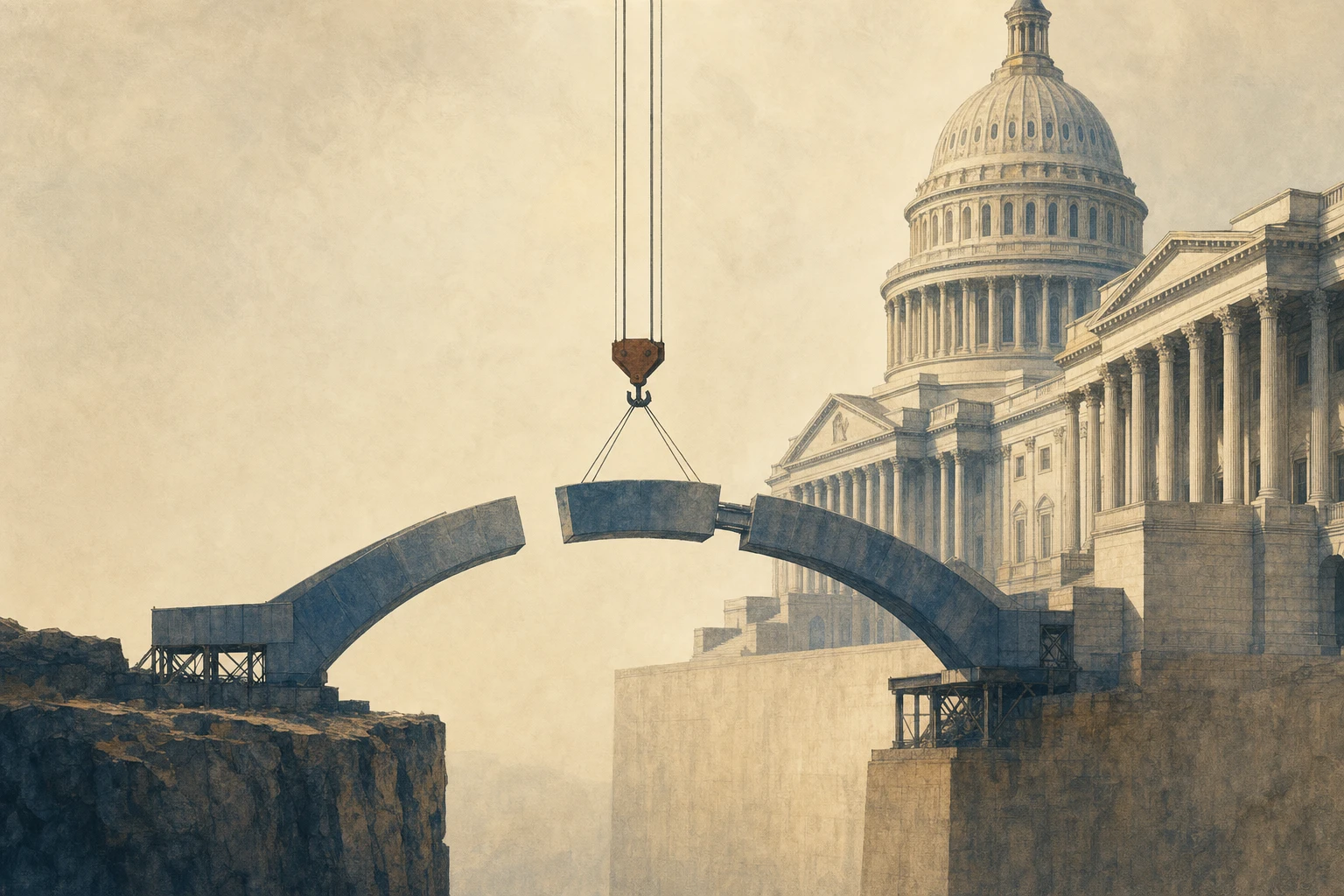
Why it matters: Conventional industrial policy subsidizes supply and hopes customers arrive. Washington now owns part of Intel, can threaten tariffs on potential customers, and can connect relief to supplier choices. That converts a grant program into a demand-coordination system. It also blurs the performance signal a foundry needs: an arranged order does not prove Intel won on yield, cost, or reliability.
The coordination problem is real. A foundry cannot improve economics without volume, while customers will not risk important designs until its process is proven. Limited Apple runs could give Intel the repetition needed to qualify harder work; Axios reported an 11% share-price jump when Trump announced the arrangement. The gamble is that compelled early demand creates a competitive supplier before a protected one.
Room for disagreement: Apple has independent reasons to diversify from TSMC: capacity is tight and a credible second source improves bargaining power. The government is a passive shareholder, has no board seat, and agreed to vote with Intel's board with limited exceptions. If Intel delivers competitive yields, political pressure may look like a bridge across a temporary coordination failure.
What to watch: Intel's 14A customer commitments and production yields matter more than its share price. A second major customer committing high-volume silicon without an accompanying tariff or procurement bargain would show that the bridge is producing a market.
AI Becomes Fieldcraft
The first durable military use of frontier AI may not be autonomous weapons. It may be a fighter with a phone asking better questions.
Researchers at Cambridge's Centre for the Analysis of Social Media and Policy interviewed 27 former Boko Haram members in northeast Nigeria during 2025 and 2026. Their new report says both Boko Haram factions used ChatGPT, Claude, Gemini, Grok, Meta AI, and DeepSeek, primarily during 2024, for attack planning, weapons troubleshooting, explosive-device design, propaganda, and routine administration. Some users reportedly circumvented safeguards.
The evidence does not show AI enabling objectives that were previously impossible. It shows something more scalable: militants substituting a commercial model for the experienced colleague, manual, translator, or instructor they did not have. The reported uses range from analyzing failed operations to adapting motorcycle tactics and troubleshooting weapons. AI is becoming fieldcraft, the accumulated practical know-how that turns an organization from a collection of people into a repeatable operation.
Why it matters: The important capability shift is a reduction in informational friction. AI does not supply explosives, trust, financing, secure communications, or disciplined execution; it can make a mediocre operator less mediocre across many small tasks. CSIS reaches the same conclusion in its separate assessment: adoption is likely to be cumulative rather than revolutionary, raising the competence of lower-level actors without replacing organizational infrastructure.
That mechanism makes lab-specific safeguards necessary but insufficient. CSIS counted 368,944 downloadable text-generation models on Hugging Face as of May 26, alongside more than 100,000 text-to-image models. Blocking one prompt on one hosted service shifts determined users toward another service, an open model, or a sequence of harmless-looking questions. The control problem therefore moves from universal refusal toward abuse detection across accounts, devices, payment rails, and repeated behavior.
Room for disagreement: The study is based on retrospective interviews with former members, covers a small and unusually difficult-to-verify population, and describes activity largely from 2024. Self-reported use can exaggerate sophistication, while failed plans are less visible than successful anecdotes. The report establishes adoption, not a causal increase in attack success.
What to watch: Look for incident-level evidence connecting AI use to changed outcomes: shorter preparation time, more reliable devices, altered targeting, or tactics that security forces had not previously observed. Adoption alone is no longer the unresolved question.
The Contrarian Take
Everyone says: Vinod Khosla's family paid a billionaire's vanity premium for the Seattle Seahawks.
Here's why that's wrong (or at least incomplete): The $9.612 billion price is 59% above the $6.05 billion paid for the Washington Commanders in 2023, but the underlying asset has features public tech stocks do not: fixed supply, no relegation, unusually durable loyalty, and league-level media contracts. Institutional investors now hold stakes in 74 North American teams, and CFA Institute's market review puts the average NFL franchise near $7 billion. Khosla may have overpaid, but the premium is also a market price for live attention that streaming fragmentation cannot manufacture.
Under the Radar
-
Phia's shopping assistant appears to manufacture attribution — Researcher Ben Edelman found code that automatically invoked affiliate links on iOS without a user click and a seven-month feature history, despite Phia describing misattribution as a recent bug. If his testing holds, the app's growth economics partly convert merchants' organic sales and publishers' referrals into Phia commissions, making attribution integrity the hidden liability behind shopping assistants. (Ben Edelman)
-
Piracy enforcement is turning shared infrastructure into collateral — Google's EU filing argues that blocking DNS resolvers, VPNs, and shared IP addresses is easy to circumvent and can disable lawful services. The evidence is not hypothetical: one Spanish football-blocking regime hit more than 554,000 domains at least once, including Amnesty International, UNICEF, Amazon S3 endpoints, and the Australian Senate. (TorrentFreak)
Quick Takes
-
Europe moved platform regulation into the product spec — The European Commission preliminarily found Meta in breach of the Digital Services Act because infinite scroll, autoplay, push notifications, and highly personalized recommendations create inadequately mitigated health risks. That is more consequential than another content-moderation fine: Brussels is treating engagement mechanics and default settings as regulated product design. (Source)
-
The Seahawks became a scarcity benchmark — The Khosla family agreed to buy the defending Super Bowl champions for $9.612 billion, subject to NFL approval, versus Paul Allen's $194 million purchase in 1997. Khosla must sell his 3.1% 49ers stake, but the bigger signal is that technology fortunes are migrating into closed-league assets whose supply cannot expand with capital. (Source)
-
Software hiring rebounded at the top of the ladder — U.S. software-development postings rose almost 15% after Claude Code launched while total postings fell 7%, but 71% of the May 2025-May 2026 increase came from senior roles and 37% from AI-titled jobs. AI may be increasing demand for experienced complements while narrowing the entry path that produces them. (Source)
The Thread
Intel and Boko Haram reveal opposite sides of coordination. Washington is concentrating equity, tariffs, and customer introductions to make one foundry viable. Frontier models diffuse know-how across many weak actors without central coordination. Industrial policy succeeds by assembling a supply chain around scarce capability; AI abuse scales by dissolving the need for that chain. The shared variable is organizational learning, not technology access.
Predictions
New predictions:
-
I predict: By October 31, at least one new U.S. tariff exemption, grant, or strategic-industry agreement will include a named customer, offtake, or supplier commitment to a government-backed company. (Confidence: medium; Check by: 2026-10-31)
-
I predict: By September 30, at least one frontier-model provider will publish a terrorism-specific enforcement change or abuse-disruption report that covers coordinated behavior across accounts rather than prohibited prompts alone. (Confidence: medium; Check by: 2026-09-30)
Issue date: July 12, 2026 · Generated: 3:34 AM ET
Tomorrow morning in your inbox.
Subscribe for free. 10-minute read, every weekday.