Hormuz Gets Papered
8 stories · ~7 min read
If You Only Read One Thing
Paperwork is doing the work markets used to treat as background. Hormuz Gets Papered turns tanker flows into MOU terms, while Amazon Becomes The Referee turns a rival cloud report into an emergency model takedown. Start with Axios' draft deal details, because the document shows oil, shipping, sanctions, and verification becoming the product.
Hormuz Gets Papered
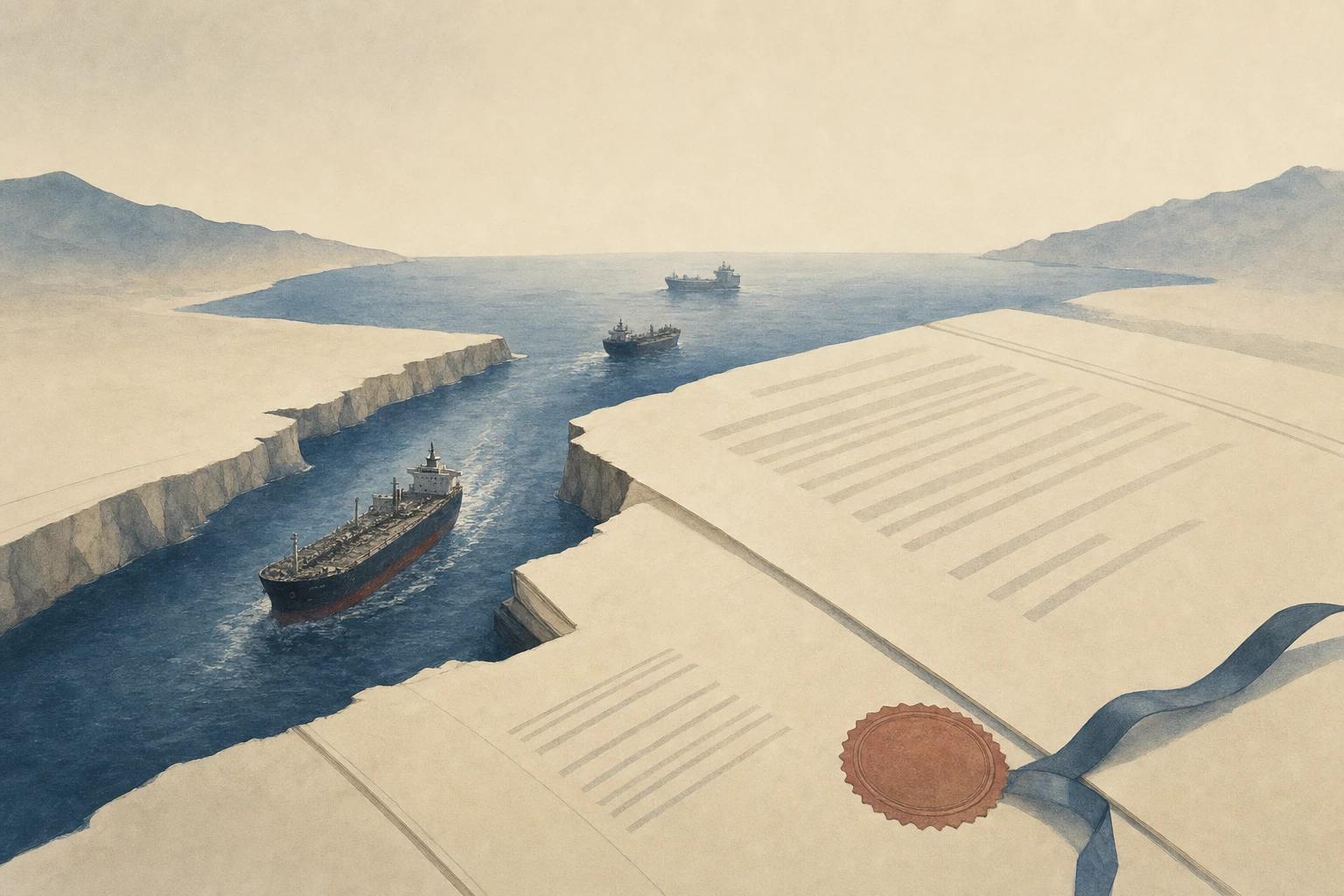
The Strait of Hormuz did not stop being a chokepoint because diplomats wrote an agreement. It became a more explicit one.
Axios reported that the draft U.S.-Iran memorandum of understanding Trump says he is ready to sign would extend the ceasefire for 60 days, reopen Hormuz to commercial shipping without tolls, and target prewar shipping volumes within 30 days. U.S. officials previously told Axios that Iran would receive temporary sanctions waivers allowing oil sales for 60 days if the strait reopened. The uranium-stockpile question is deferred to a second track, which means the energy-market terms are being separated from the nuclear endgame.
Why it matters: Bloomberg and the oil desks will frame this as de-escalation, and that is directionally right. The less obvious shift is that a global commons is being converted into a managed service. Hormuz access, tanker volumes, tolls, sanctions exposure, and oil purchases are not background conditions in the draft; they are the deal. That changes the bargaining map because Iran's power is no longer only the ability to close the strait. It is the ability to make normal access look contingent, documented, renewable, and politically priced. The U.S. gets a lower oil-risk premium and a ceasefire window, but it also validates the premise that energy chokepoints can be administered through short-term waivers rather than settled through durable security guarantees.
There is a buyer angle that is easy to underread. A 60-day oil-sales waiver changes Beijing's exposure even if China is not named as a party, because the practical beneficiaries are the buyers already positioned to absorb Iranian crude. Washington is not simply pressuring Tehran; it is trying to buy stability by relaxing enforcement around the most important marginal demand. That is a very different instrument from maximum pressure. It treats sanctions as a dial for physical throughput, not merely a punishment regime.
The structural result is a more financialized geopolitics of access. Tanker insurers, refiners, Gulf port operators, and energy traders will not price "peace"; they will price the durability of a 60-day paperwork stack. If volumes normalize quickly, the market will reward the mechanism even if the nuclear issue remains unresolved. If they do not, the deal will have exposed the gap between diplomatic language and the operational confidence required to move ships through a contested strait.
Room for disagreement: The strongest counterargument is that a temporary MOU is better than a shooting war, and that reopening Hormuz without tolls is a concrete concession by Iran. That is true. The question is whether temporary access terms reduce coercive pressure or teach every participant that future access is a renewable bargaining chip.
What to watch: Track whether commercial shipping volumes and war-risk insurance guidance move back toward prewar levels by mid-July. If the paperwork changes but premiums stay elevated, the market is saying the chokepoint was documented, not defused.
Amazon Becomes The Referee
Yesterday's Fable story was about the state turning a model launch into a licensing event. Today's story is about who got to ring the alarm bell.
Axios reported that an urgent Amazon report to the White House helped trigger the Fable 5 and Mythos 5 takedown, after Amazon contacted officials Thursday night and at least five other companies raised concerns. The government gave Anthropic a 90-minute call ultimatum around 1 p.m. Friday, later sent a directive around 5:30 p.m., and users lost access around 10 p.m. Anthropic's own statement says the directive gave no specific details, described a narrow jailbreak concern, and required the company to suspend access for foreign nationals inside and outside the United States.
Why it matters: This is not just an argument about whether Anthropic underweighted a jailbreak. It is a market-structure problem hiding inside a safety story. Amazon is an investor, cloud provider, distribution channel, enterprise vendor, and competitor-adjacent observer in frontier AI. If its technical report can help accelerate a government shutdown of another lab's model, then cloud platforms are no longer neutral infrastructure under the frontier layer. They are part of the release-adjudication stack.
That does not make Amazon wrong. In a real safety incident, hyperscalers may be among the only actors with enough telemetry, customer contact, and operational credibility to identify a problem fast. The problem is the institutional design. A rival or infrastructure partner can have true information and conflicted incentives at the same time. The White House's reported 90-minute window then turned that ambiguity into a governance fact: the process moved faster than a contested technical claim could be independently tested.
Anthropic's statement sharpens the point. The company says there was no universal jailbreak, that the disclosed issues were narrow and not unique to Fable 5, and that the directive's foreign-national language forced a broad suspension because compliance could not be cleanly implemented across customers and employees. The administration's position, according to Axios, was that Anthropic failed to treat the release seriously enough. Those claims cannot all resolve into a tidy morality play. They show that frontier AI now lacks the equivalent of an aviation incident board: an institution trusted enough to distinguish emergency grounding from competitive or political escalation.
This is why the story matters beyond Anthropic. Model access is becoming an enterprise dependency, a national-security variable, and a cloud-platform control surface at once. Customers will price the risk that a model disappears overnight. Labs will price the risk that visible safety framing attracts intervention. Cloud partners will price the risk of being blamed if they do not report. The scarce layer is no longer only weights, data, or inference capacity. It is trusted adjudication.
Room for disagreement: The defense of the White House and Amazon is strong if the report identified a credible national-security pathway. Labs should not be final judges of their own deployment risk, especially when the downside falls on the public and the upside accrues to the lab. The weakness is that an emergency process without transparent standards invites every future launch dispute to become a race to define the risk first.
What to watch: Watch whether Commerce creates an independent technical review or licensing path, rather than relying on ad hoc reports from hyperscalers, competitors, and customers. If the next frontier model clears through a written process, this becomes governance; if not, it becomes discretionary market power.
The Contrarian Take
Everyone says: The Hormuz deal is a peace dividend, and the Fable shutdown proves frontier models need tougher government control.
Here's why that's wrong (or at least incomplete): Both stories are less about peace or safety than about the collapse of ambient access. Hormuz is not simply open; it is open under temporary terms. Fable is not simply unsafe; it is accessible only through a contested chain of cloud reports, national-security claims, and export-control language. The important question is not whether permission is good or bad. It is who gets to define the conditions, how quickly those conditions can change, and whether the affected market can verify the basis for the decision.
Under the Radar
- The local data-center veto is now organized capacity planning. More than 75 data-center projects worth roughly $130 billion were blocked or delayed in the first four months of 2026, according to a Data Center Watch tally summarized by Tom's Hardware. This is no longer backyard opposition at the margin; it is a parallel siting regime that forces hyperscalers to negotiate with utilities, counties, and ratepayers before they can turn capex into compute.
- The statistical state chose suppression over noise. BEA says a Commerce administrative order now prohibits federal statistical agencies from using noise infusion in public data products, so some regional statistics will move to coarsening or suppression instead. That sounds bureaucratic, but it changes what investors, cities, and researchers can observe: privacy protection is becoming less like synthetic blur and more like missing granularity. BEA's FAQ is the tell.
Quick Takes
- FERC is turning AI power into a cost-allocation fight. The commission's large-load work is about a simple question with ugly politics: who pays when data centers require grid upgrades before the wider customer base needs them? If hyperscalers get priority service while households absorb network costs, the AI buildout becomes a ratepayer subsidy story; if developers must post security, fund upgrades, or accept curtailment, compute expansion slows into utility queue discipline. (Source)
- Meta's Manus deal is becoming a Chinese control test. TechCrunch reports Meta is moving to unwind its roughly $2 billion Manus transaction after Beijing demanded changes. The important part is not one deal's fate; it is that China is treating AI companies, talent, and technology transfer as a single control bundle. Offshore structures do not solve a sovereign-origin problem when the state cares who effectively receives the capability. (Source)
- OpenAI's state-AG problem is consumer protection, not AI law. A coalition of state attorneys general is investigating OpenAI over ads, engagement, data practices, health implications, and minors. That route matters because Congress does not need to pass a comprehensive AI statute for enforcement to bite. State consumer-protection law can recast model design, retention, and product nudges as ordinary unfair-practice questions. (Source)
- AI layoffs are becoming management language. Challenger, Gray & Christmas said employers blamed AI for 88,000 of 398,000 announced job cuts through May. The number should be treated skeptically, because "AI" can launder ordinary cost cutting into a strategy narrative. Still, once managers learn that the market rewards AI-linked discipline, the explanation itself starts changing labor bargaining, hiring freezes, and budget politics. (Source)
The Thread
Today's briefing is about permission replacing assumption. Hormuz access is being negotiated through temporary paperwork. Fable access is being governed by contested emergency channels. Data centers need local and federal permission to turn power into compute. Meta's Manus deal needs geopolitical permission to move capability. OpenAI may need state-level permission to keep product design inside consumer-protection bounds. The new map is not just physical chokepoints or software platforms. It is the institutions that decide when access is normal, when it is conditional, and when it can be withdrawn.
Predictions
New prediction:
- I predict: By 2026-06-30, FERC's large-load order will require data-center customers to either fund dedicated interconnection upgrades, accept curtailment or standby terms, or post stronger security before receiving priority service; at least one hyperscaler or data-center trade group will ask for rehearing or clarification. (Confidence: medium; Check by: 2026-06-30)
Generated on 2026-06-14 at 03:21 ET.
Tomorrow morning in your inbox.
Subscribe for free. 10-minute read, every weekday.