The Bill Finds Platforms
8 stories · ~7 min read
If You Only Read One Thing
Texas data centers and Canada's Safe Social Media Act look like backlash. They are actually invoices for digital externalities. The single most useful primary document is Abbott's directive, because it shows the AI boom moving from narrative to rate design: who gets power, who pays for wires, and who carries platform safety costs.
Texas Reprices the Load
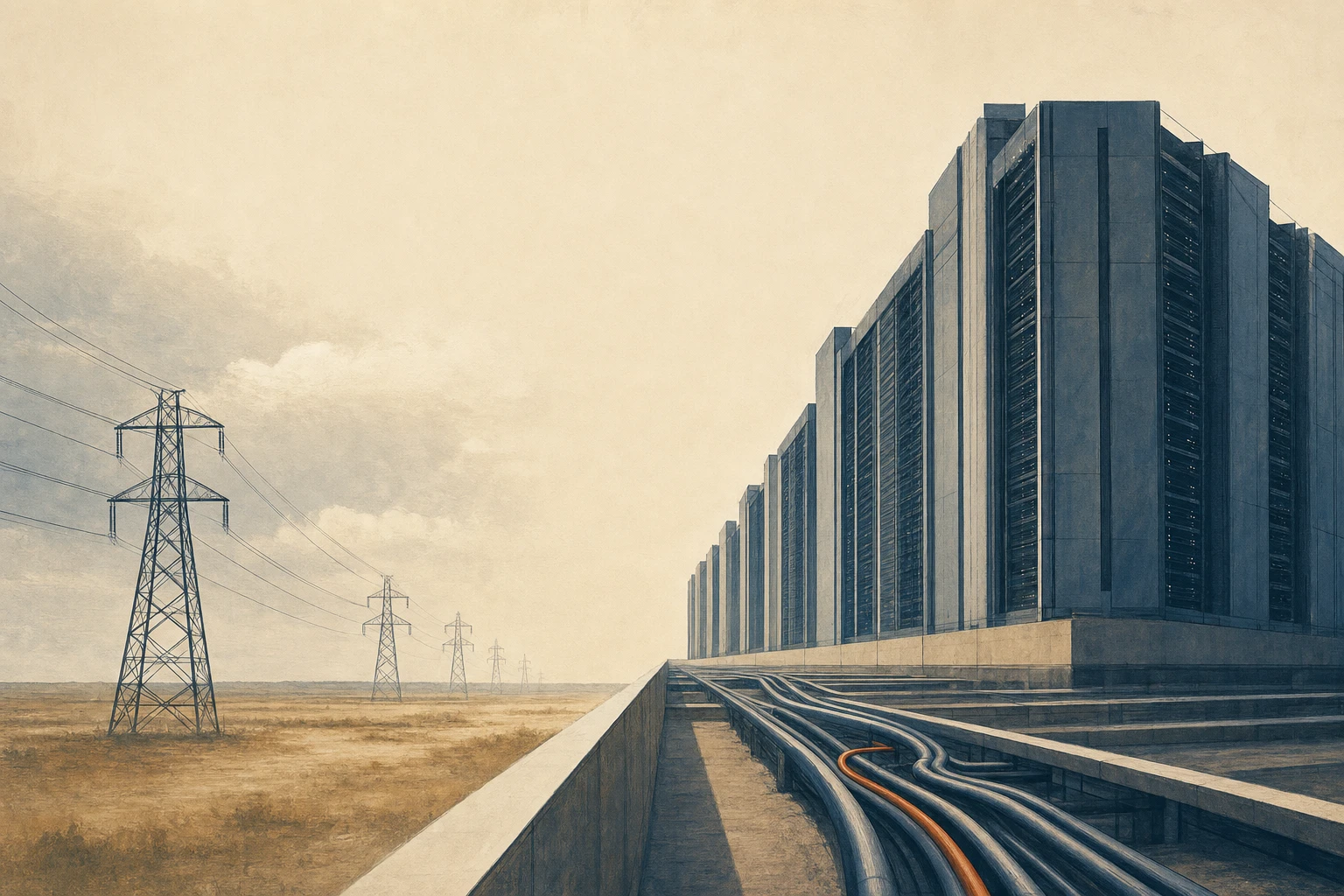
Texas did not turn against data centers. It turned against letting data-center economics hide inside everyone else's electric bill.
On June 10, Gov. Greg Abbott directed the Public Utility Commission of Texas and ERCOT to shield residential and small-business customers from infrastructure costs created by data-center growth. The order asks regulators to identify transmission, interconnection, and related grid costs tied to data centers and make sure those costs are not shifted to ordinary ratepayers.
Why it matters: The old economic-development bargain treated big electric loads as trophies. If a factory, crypto mine, or cloud campus created enough jobs and tax base, utilities and local officials could justify socializing some grid upgrades through the rate base. AI data centers break that bargain because their power appetite is enormous, their job count is modest after construction, and their economic upside is captured by hyperscalers, landlords, chip vendors, and cloud customers far from the substation. Abbott's move is therefore less anti-tech than pro-cost-causation: if one customer requires a new wire, transformer, or queue position, that customer should absorb more of the financial risk.
The structural shift is that grid access is becoming a balance-sheet line item for AI infrastructure. Large-load developers can still build in Texas, but the financing model changes if they must post stronger interconnection security, fund dedicated transmission, or accept curtailment terms before receiving priority service. That is a meaningful constraint on neoclouds and speculative campus developers whose pitch depends on announcing capacity before all of the utility work is priced. It also gives incumbent hyperscalers an advantage: they have the balance sheets, power-trading teams, and long-term procurement machinery to absorb cost-allocation rules that weaker developers cannot.
Room for disagreement: The best case for socializing some of these costs is that grid upgrades are not single-customer assets. A new transmission line can improve reliability, connect generation, and support future industrial load beyond the first data center. Push too much cost onto the first mover and Texas may slow the very infrastructure buildout that keeps energy-intensive industries in the state.
What to watch: Watch whether other high-load states copy Texas before federal energy regulators act. If Virginia, Georgia, or Arizona opens a similar cost-allocation proceeding this summer, the AI data-center race will become a state-by-state tariff fight, not just a land and power procurement race.
Canada Builds the Age Gate
Canada's new online-safety bill is sold as a protection for children. Operationally, it is a decision to make platforms prove who is allowed to be there.
The government introduced Bill C-34, the Safe Social Media Act, on June 10. The bill would create a Digital Safety Act and a Digital Safety Commission of Canada, impose duties on social media services and AI chatbot services, target seven categories of harmful content, require Digital Safety Plans, and move toward a 16-year-old minimum age for social-media accounts unless a service receives an exemption for sufficient safeguards.
Why it matters: The important move is from moderation to architecture. Traditional online-harms law asks platforms to remove specific bad content. Canada's bill asks services to design safer defaults, label synthetic content, publish safety plans, provide reporting and blocking tools, and enforce age-appropriate access. That pushes regulation into product design, identity, recommender systems, and compliance reporting - the operating system of social platforms, not just the abuse queue.
That is also why the law will advantage incumbents even if it is aimed at them. Meta, Google, Snap, TikTok, and large adult-content platforms can staff regulatory teams, buy age-assurance vendors, publish transparency plans, and negotiate exemptions. Smaller social products, forums, live-streaming communities, and Canadian startups face a harsher trade: implement identity checks they do not want, restrict features, or avoid the market. The likely winner is not simply government. It is the compliance layer: identity vendors, trust-and-safety contractors, audit firms, and the large platforms that can convert regulation into a scale cost.
Michael Geist's critique is the strongest version of the objection. He argues that an under-16 ban necessarily becomes age verification for everyone, because a service cannot identify minors without testing adults too. The government can call the restriction temporary, but the identity machinery, regulator, and compliance vendors become permanent once deployed.
Room for disagreement: The case for Canada is not trivial. The bill targets child sexual exploitation, non-consensual intimate images, bullying, self-harm inducement, hate, violence, and terrorism content, and voluntary platform action has plainly not solved those problems. A law that pressures platforms to change default design, not merely chase posts after the fact, is more serious than a headline ban.
What to watch: Watch the implementation path for age assurance. Privacy-preserving credentials would make the bill a design-regulation experiment; broad third-party ID checks would make it an identity-infrastructure law.
The Contrarian Take
Everyone says: Today's stories are mostly about backlash: Texas against data centers, Canada against social media, regulators against prediction markets, and security agencies against slow patching.
Here's why that's wrong (or at least incomplete): This is not backlash so much as accounting. Texas is identifying which users cause grid costs. Canada is asking which platforms create child-safety and identity risks. The CFTC is deciding which event contracts deserve federal market treatment rather than gambling treatment. CISA is compressing the time between exploitability and remediation. The common move is to convert diffuse digital externalities into named obligations with clocks, invoices, and regulated owners.
Under the Radar
-
The chatbot clause is the sleeper in Canada's bill. The headlines focus on social media age limits, but Bill C-34 also gives AI chatbot services a tailored duty to mitigate harmful responses and implement emergency measures in crisis situations. That pulls companion bots, tutoring systems, and mental-health-adjacent chat interfaces into the same safety architecture as feeds.
-
Applied Materials is moving the bottleneck upstream. Applied opened a US$500 million Tampines campus in Singapore that more than doubles its advanced cleanroom capacity there and is already in volume production. The visible AI supply chain is Nvidia and TSMC; the slower bottleneck is often the equipment needed to expand fabs in the first place.
Quick Takes
-
The CFTC is drawing a prediction-market boundary. The agency proposed a structured framework for event contracts involving terrorism, assassination, war, gaming, or unlawful conduct, with a 90-day review process and public-interest factors. Prediction markets are not being killed; they are being sorted into products that look like derivatives and products that look too much like regulated gambling or public-harm wagering. (Source)
-
CISA made patching a latency problem. BOD 26-04 tells federal civilian agencies to prioritize security updates based on risk signals such as public exposure and known exploitation, with the most urgent fixes moving on a 48- to 72-hour target timeline. The private-sector read is obvious: vulnerability management is becoming an operational response-time metric, not a quarterly hygiene exercise. (Source)
-
Oracle's backlog now comes with financing math. Oracle reported record fiscal 2026 results, including $638 billion of remaining performance obligations, but also negative $23.7 billion of free cash flow as it builds AI cloud capacity. The company says prepaid and customer-supplied hardware reduce the amount it must raise, yet still expects about $40 billion of debt and equity financing in fiscal 2027. AI cloud is becoming project finance with software multiples attached. (Source)
-
Anthropic wants the rulebook written around frontier testing. Dario Amodei called for binding rules that could require testing and block dangerous frontier deployments, days after Anthropic's Fable/Mythos access design triggered criticism over capability restrictions. The political economy is clear: the labs with safety infrastructure want regulation that turns that infrastructure into the entry fee. (Source)
The Thread
The thread is cost assignment. The AI boom, child-safety debate, prediction-market fight, vulnerability-management shift, and chip-equipment expansion all look different on the surface, but they share a constraint: systems scaled faster than the institutions that price their spillovers. Today's institutions are catching up by naming the payer, the verifier, the reviewer, the patch owner, and the supplier. That is the next phase of tech policy: not whether a system is allowed to exist, but which actor has to carry the cost of making it legible and safe enough to operate.
Predictions
New predictions:
- I predict: By 2026-08-31, the PUC of Texas or ERCOT will publish a large-load cost-allocation proposal that requires data centers to post stronger upfront interconnection security, fund dedicated transmission, or accept curtailment terms before receiving priority service. (Confidence: medium; Check by: 2026-08-31)
- I predict: By 2026-09-30, at least one large platform, civil-liberties group, or Canadian privacy authority will seek to narrow or delay the Safe Social Media Act by framing age assurance as a privacy or Charter problem rather than a content-moderation problem. (Confidence: medium; Check by: 2026-09-30)
Generation metadata: 2026-06-11 03:27 ET
Tomorrow morning in your inbox.
Subscribe for free. 10-minute read, every weekday.